Silicon Valley
Pied Piper
The compression company's strategic decisions, from the middle-out algorithm architecture to the PiperNet decentralized internet.
- 15 records
- 12 people
- 8 teams
A text-based knowledge graph for architecture decisions, policies, opportunities, incidents, specs and processes. Plain Markdown in your repo, validated against a schema, reviewed in pull requests.
$ dg init
$ dg new opportunity "Sell llama milk online"
OPP-001 -> docs/opportunities/opp-001-sell-llama-milk-online.md

$ dg new adr "Use PostgreSQL" enables OPP-001
ADR-001 -> docs/architecture/adr-001-use-postgresql.md

$ dg serve --open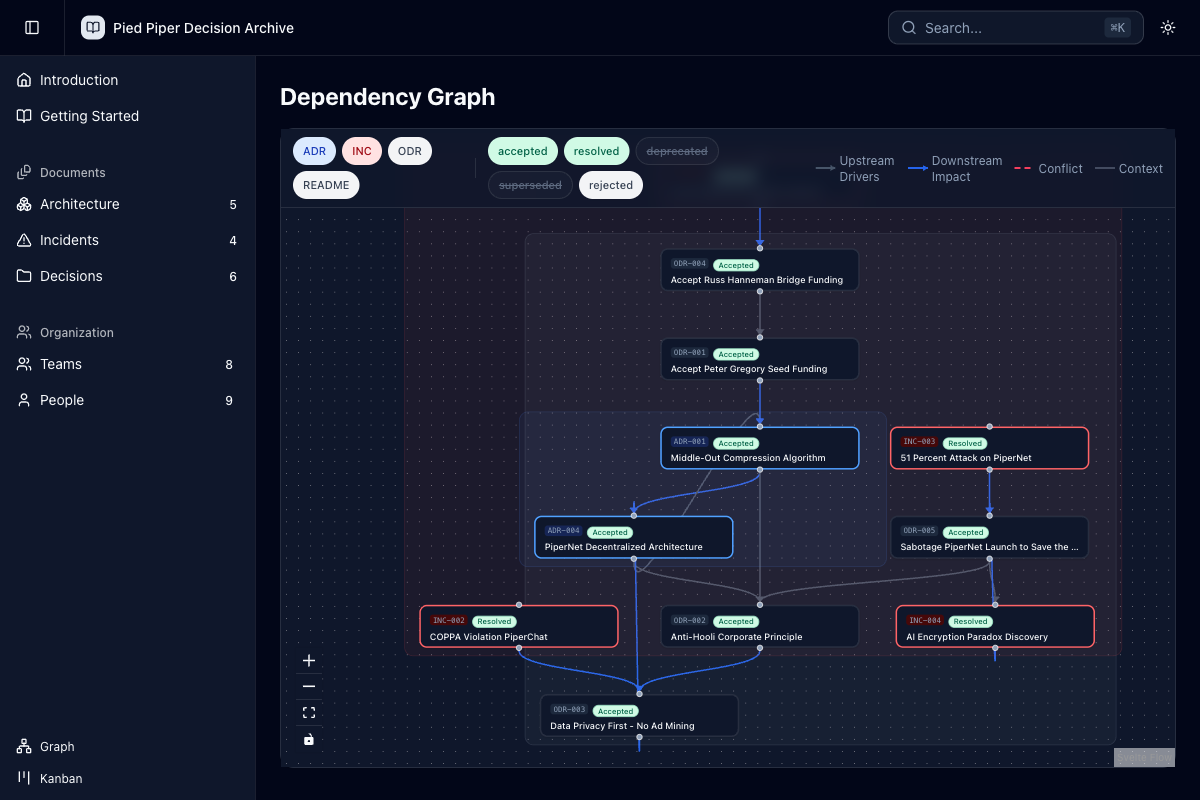
dg serveMarkdown files with YAML frontmatter. Review decisions in PRs, track history with git blame, merge conflicts are just text.
Architecture Decision Record, Policy Document, Opportunity, Incident Report, Behavioral Specification / User Story and Process Document. A KDL schema defines required fields, sections
and status transitions; dg validate enforces it. Eject and add your own types.
Connect records with typed relations: supersedes, enables, triggers, depends_on, implements, conflicts_with and related. Backlinks come for free; dg lint catches dangling refs, cycles and orphans.
dg serve launches a local site with search, an interactive graph, kanban,
roadmap and team pages. dg export --site builds the same site as static files.
dg init sets up skills and instructions for Claude Code, Gemini CLI and OpenCode.
Agents write docs with dg new / dg set and get instant schema
feedback from dg validate.
Define people, teams and orgs in .dg/org.kdl. Authors, owners and action-item
assignees are validated, and departed users are tracked.
Explore decision archives built with Decision Graph
The compression company's strategic decisions, from the middle-out algorithm architecture to the PiperNet decentralized internet.
Historical decisions from Microsoft's founding through the Satya Nadella era. Based on the excellent Acquired podcast episodes.
6 built-in types, straight from the default schema.
Sections: Context · Decision · Consequences
Status: proposed · accepted · rejected · deprecated · superseded
Sections: Purpose · Policy · Scope
Status: proposed · active · deprecated · superseded
Sections: Description
Status: identified · validating · pursuing · completed · deprecated · declined
Sections: Summary · Timeline · Root Cause
Status: open · mitigated · resolved
Sections: Story · Scenarios
Status: draft · proposed · approved · implemented · deprecated
Sections: Overview · Inputs and Prerequisites · Outputs · Process Flow · Steps
Status: draft · proposed · active · deprecated · superseded
Plus 3 README types
(readme, service-readme, app-readme):
dg checks that project, service and app READMEs document architecture, risks and local
development.
macOS and Linux:
$ brew install decisiongraph/tap/dgOr grab a prebuilt binary from GitHub Releases.
The repo is a Nix flake exposing a dg package:
# run without installing
$ nix run github:decisiongraph/dg -- --version

# install to your profile
$ nix profile install github:decisiongraph/dg
Prebuilt binaries for x86_64-linux, aarch64-linux and aarch64-darwin are in the decisiongraph cachix: cachix use decisiongraph.
Use the prebuilt release binaries (no compiling). In devenv.yaml:
inputs:
  dg:
    url: github:decisiongraph/dg
    flake: false
and in devenv.nix:
{ pkgs, inputs, ... }: {
  packages = [ (pkgs.callPackage "${inputs.dg}/nix/dg-bin.nix" { }) ];
}
devenv update dg moves to the latest release.
Build from source (needs Rust and bun for the embedded web UI):
$ cargo install --locked --git https://github.com/decisiongraph/dg dg-cliOr from a checkout:
$ git clone https://github.com/decisiongraph/dg && cd dg
$ cargo install --path crates/dg-cli# Scaffold .dg/, git hooks and AI agent config
$ dg init
# Create linked records
$ dg new opportunity "Sell llama milk online"
$ dg new adr "Use Rails with PostgreSQL" enables OPP-001
$ dg new spec "Llama milk checkout flow" implements OPP-001
# Validate against the schema + graph health
$ dg lint
# Find things
$ dg list --type adr
$ dg search "postgres"
$ dg refs OPP-001 --backlinks
# Browse locally, or export a static site
$ dg serve --open
$ dg export --site -o ./siteYour future self will thank you when you can trace why that architecture decision was made.